
Everything we make starts with a living tree.
Our mats use cork from the cork oak and natural rubber from the rubber tree. Our blocks and roller are made from cork alone.
Getting those materials from a tree to something you can actually practice with is a little more involved.
Natural rubber: tapped at daybreak
Natural rubber starts as latex, a milky liquid found in vessels in the bark of Hevea brasiliensis, a tree native to the Amazon basin.
Today, most rubber trees grow in Asia, where about 6 million smallholders produce more than 85% of the world’s supply.
A rubber tree is usually first tapped five to seven years after planting. And the work starts early.
Very early.
Tappers begin at daybreak because the pressure inside the tree’s latex vessels is highest before dawn. As the day warms, the pressure drops. By afternoon, tapping can produce about a third less latex.
The tapper uses a special knife to shave a very thin strip of bark—about 1.5 mm—on a slope partway around the trunk.
The cut opens the latex vessels but stops short of the cambium, the living layer underneath that keeps the tree growing.
The latex runs down the cut, along a small spout and into a cup.
Done carefully, the tree survives and keeps producing.
Over-tapping can cause something called tapping panel dryness, where the latex stops flowing. When the trees are tapped responsibly, they can remain productive for around 25 to 30 years.
After that, the trees are felled, the land is replanted, and the trunks can be sold as rubberwood.
Fresh latex is only about 30–40% rubber. From there, it can be turned into raw rubber in a couple of common ways.
Sheets: the latex is set with acid, usually formic acid, then pressed through rollers and dried in a smokehouse into ribbed smoked sheet.
Cup lump: many smallholders simply let the latex set in the collection cup. Factories then crush, wash and dry the lumps into block rubber.
That rubber eventually becomes the base of our mats.
Cork: bark from a living oak
Cork comes from the outer bark of the cork oak, Quercus suber.
The tree grows naturally in the western Mediterranean, and Portugal is home to more than 730,000 hectares of cork oak forest. It also produces about half of the world’s cork.
Our cork comes from Portugal.
And this is where cork gets pretty interesting.
The tree isn’t cut down.
Under Portuguese law, a cork oak can be stripped for the first time only once its trunk measures at least 70 cm around, measured 1.3 metres above the ground. That usually takes about 25 years.
Harvesting takes place from around mid-May or early June through mid or late August, when the layer that produces cork is actively dividing and the bark can be removed cleanly.
Skilled harvesters, known as descortiçadores, do the work by hand.
They use a specialized axe to make vertical and horizontal cuts, then carefully lift the bark away in planks. It’s precise work. A cut too deep into the inner layer can wound the tree and allow infection in.
Once the cork is removed, the tree simply grows a new layer.
Portuguese law requires at least nine years between harvests, although in some regions the gap is closer to 14 years.
Each harvested tree is marked with the last digit of the harvest year. So a tree harvested in 2026 would carry a little “6” on its trunk.
Over roughly 200 years, one cork oak can provide around 15 harvests.
The bark comes off.
The tree stays.
From bark to cork granules
Freshly stripped cork planks are left outdoors for at least six months.
After that, they’re boiled in clean water for at least an hour. This cleans the cork and makes it thicker and more elastic.
The cork used for wine stoppers comes only from the third harvest, roughly 43 years after planting. The first two harvests are too irregular for stoppers, so they have another life.
They’re ground into cork granules, along with the offcuts left behind when stoppers are punched out.
Those granules are what we use to mould our blocks and roller.
So, what does FSC certification actually mean?
Our cork and natural rubber are both FSC certified.
The Forest Stewardship Council is an international non-profit founded in 1993. Its certification covers cork and natural rubber forests as well as timber.
Certified forests are audited against FSC’s ten principles, covering things like workers’ and Indigenous Peoples’ rights, environmental impact, and how the forest is managed and monitored.
From material to mat, block and roller
So what actually happens to all of this cork and rubber once it gets to us?
Here’s the simple version:
| Product | Made from | How |
|---|---|---|
| Mats, 3mm and 6mm | Cork top, natural rubber base | Heat-bonded |
| Block set | Fine-grain cork granules, nothing added | Moulded under pressure |
| Roller | Coarser-grain cork granules, nothing added | Moulded under pressure |
The mat
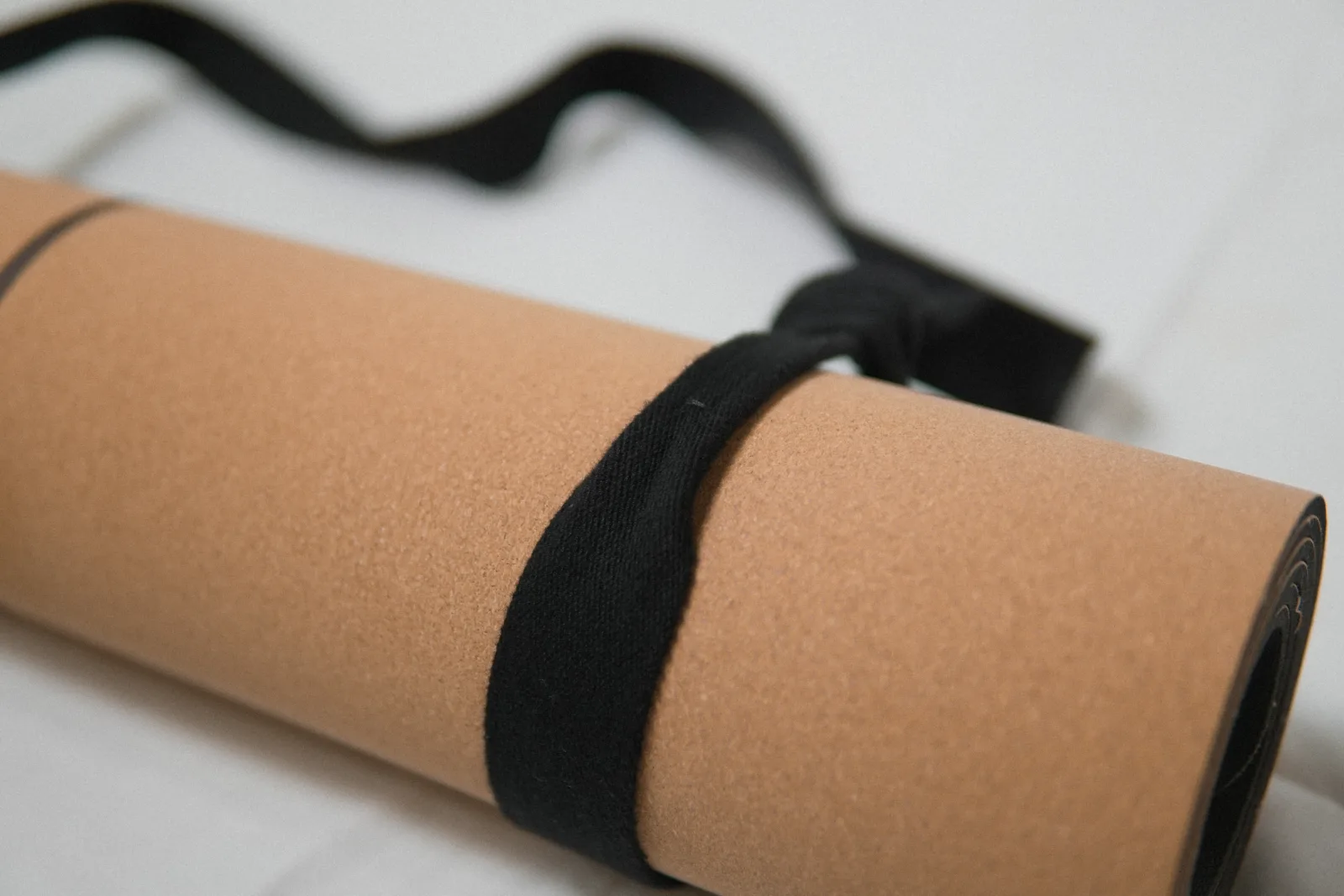
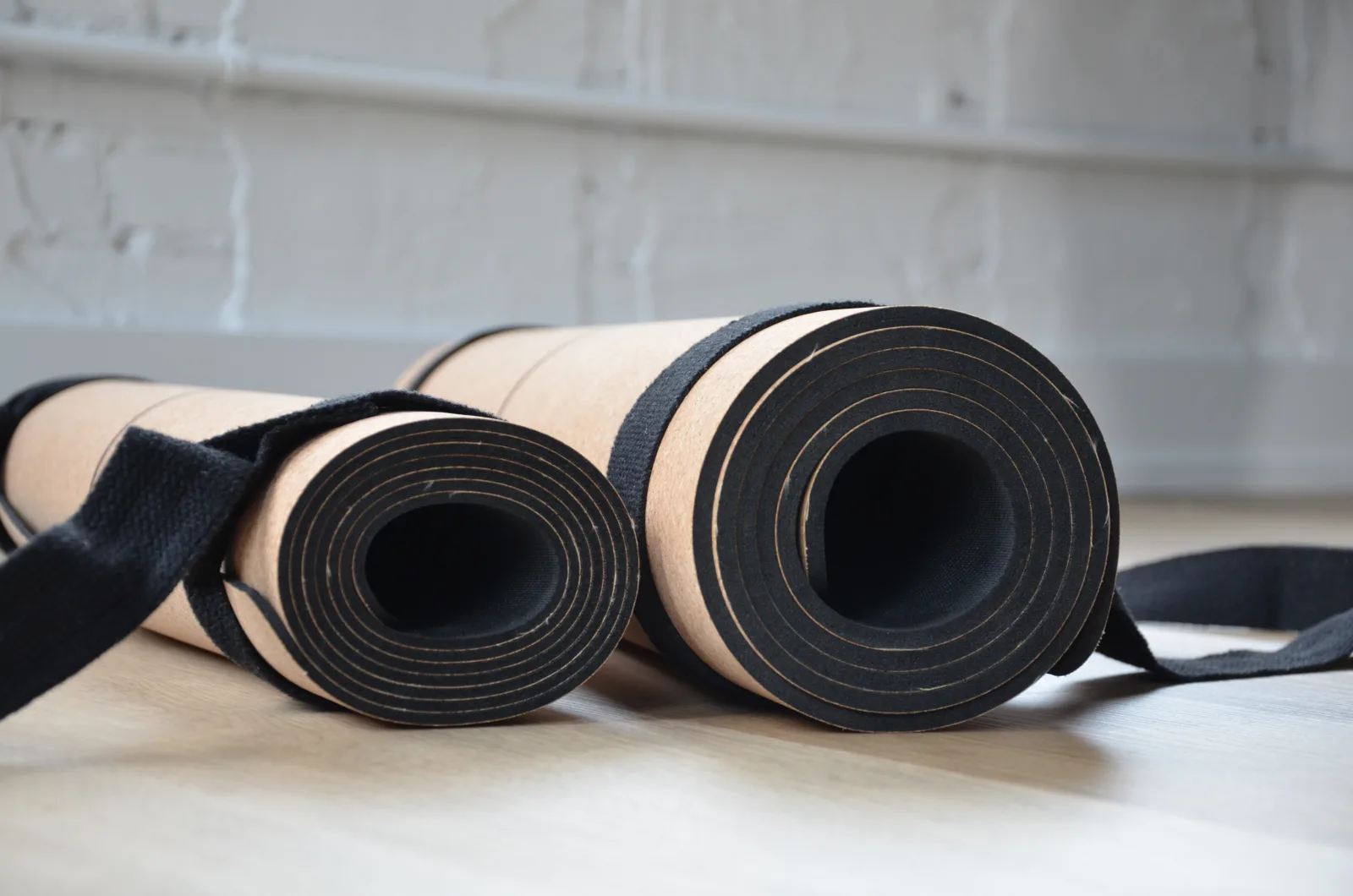
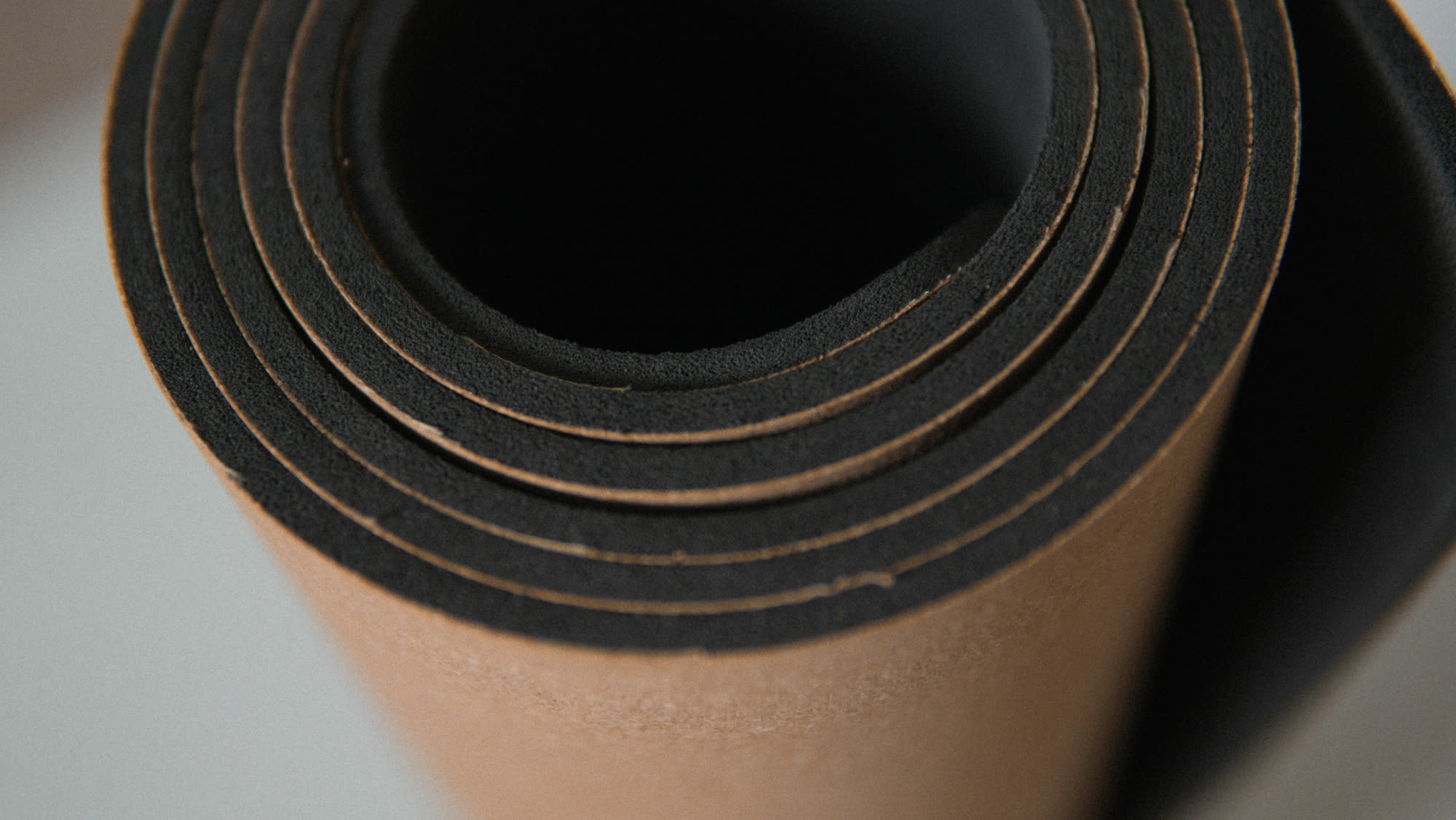
The cork top is heat-bonded to the natural rubber base using water-based adhesives.
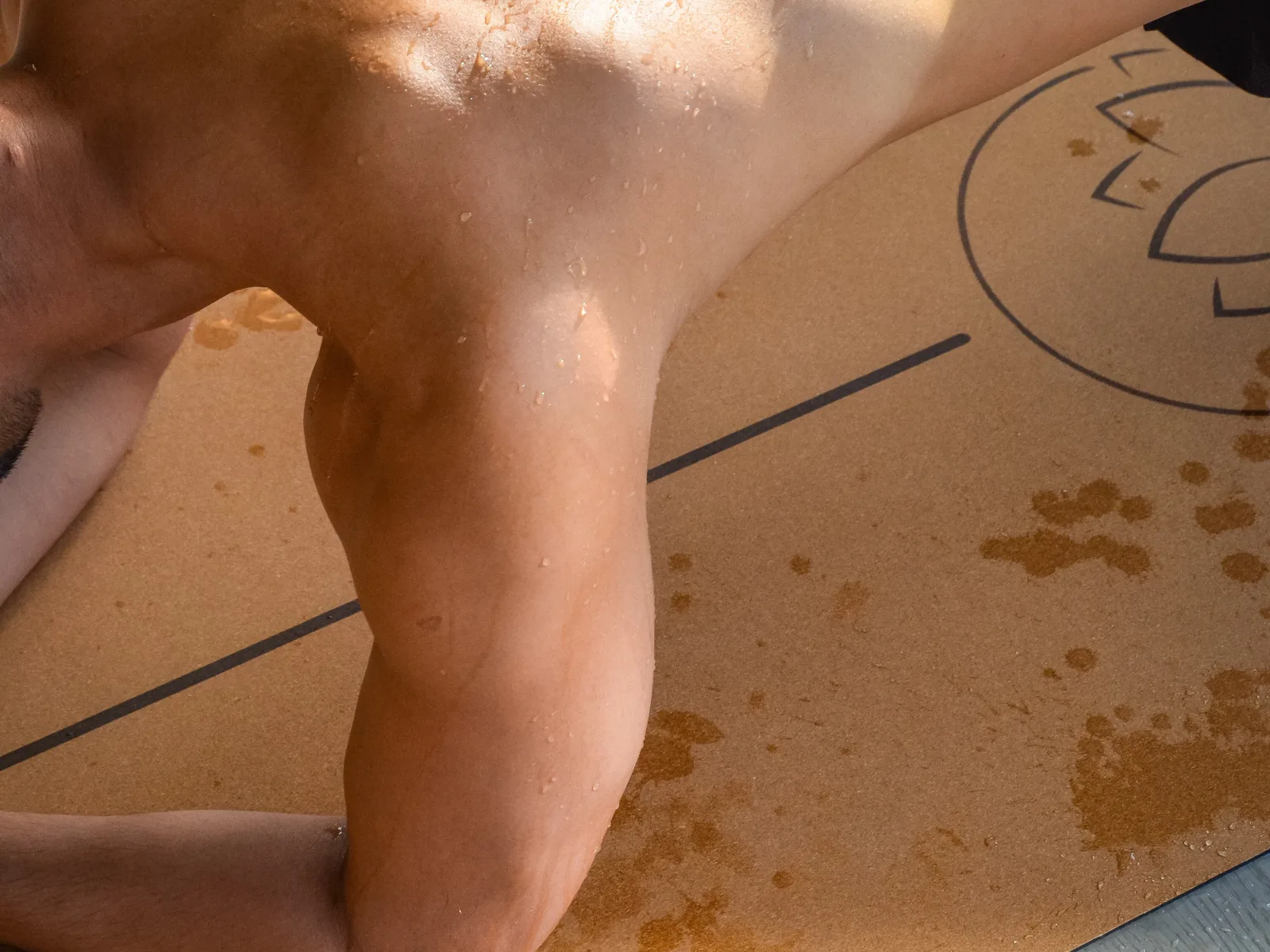
The cork gives you grip—and gets grippier as you sweat.
The rubber base adds cushion underneath and helps keep the mat in place.
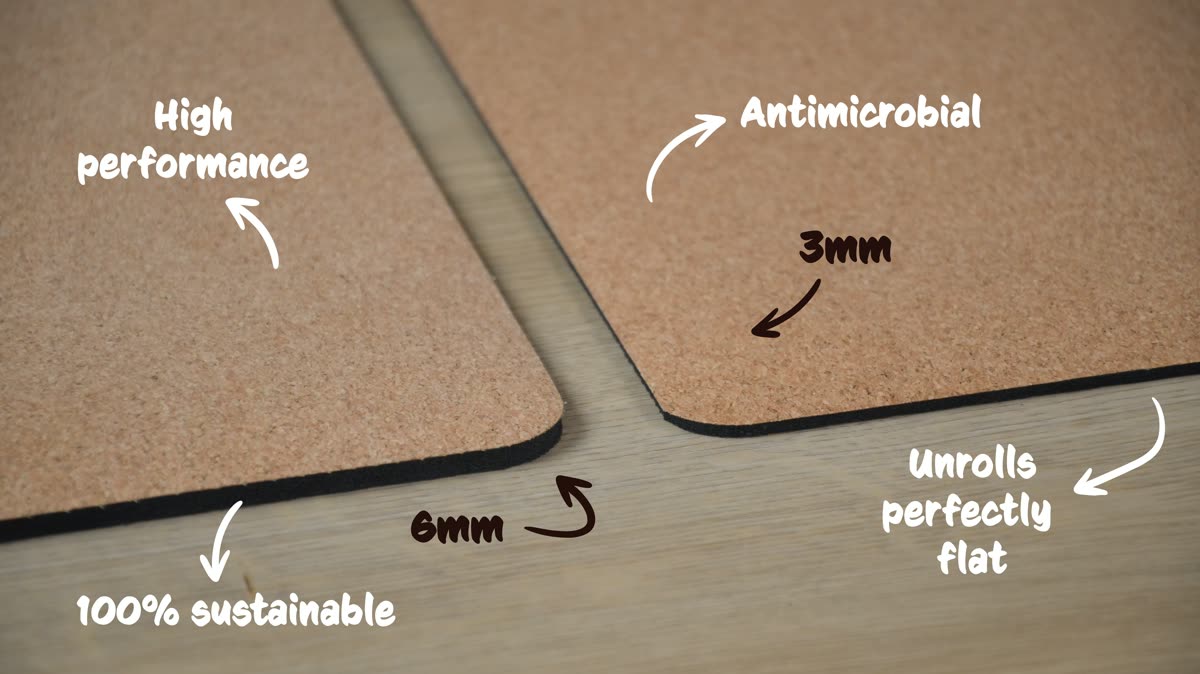
The 3mm cork yoga mat and 6mm cork yoga mat are made in exactly the same way. The difference is thickness: the 6mm has a thicker natural rubber base and weighs almost twice as much.
If you’re trying to decide between them, we break it all down in 3mm vs 6mm.
One important note: because the base is natural rubber, our mats aren’t suitable for anyone with a latex allergy.
The blocks
A lot of cork products made from granules use a binder, often polyurethane, to hold everything together.
We don’t.
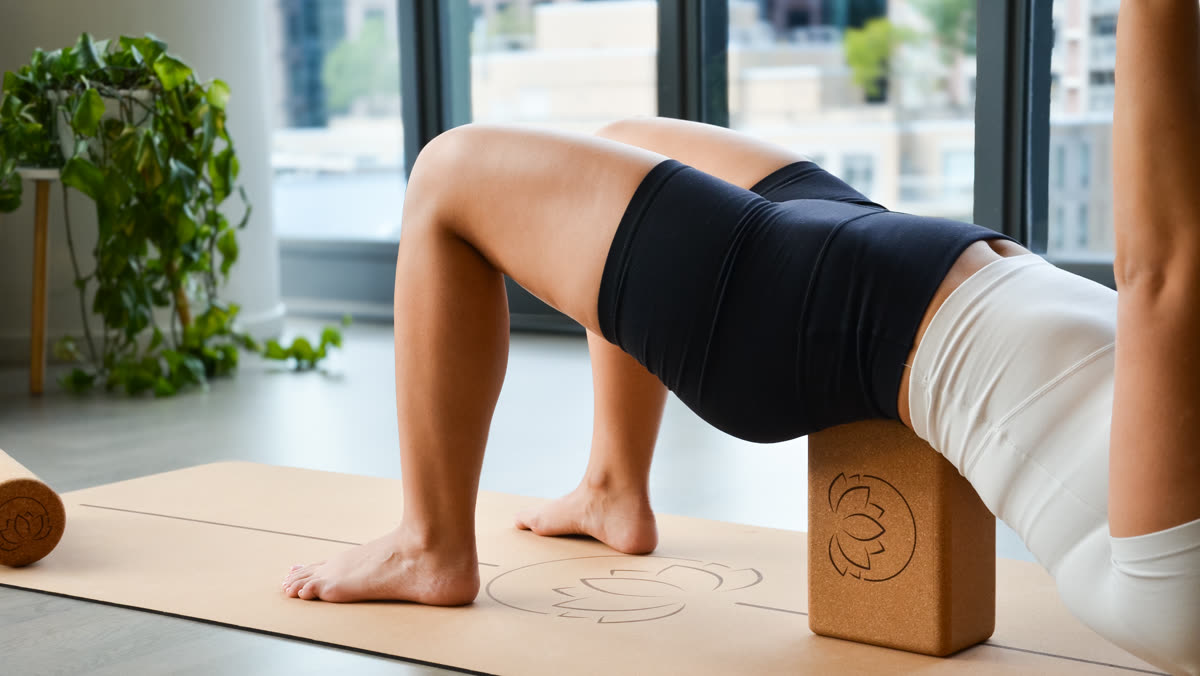
Our cork yoga block set is made from cork granules alone, with nothing added.
We use a fine grain and mould it under pressure. The result is a dense, durable block with firm support that doesn’t compress.
The set includes two blocks, each measuring 23 × 15 × 10 cm (9 × 6 × 4 in).
And because cork is naturally antimicrobial, they’re pretty low-maintenance too.
The roller
Our cork massage roller is made from cork granules in the same basic way.
The difference is the grain.
We use a coarser grain for a more textured surface. It stays firm and gives deep, consistent pressure.
Like the blocks, it’s naturally antimicrobial.
It measures 10 × 30 cm (4 × 12 in).
From tree to your floor
There’s a lot that happens before you unroll a mat.
A rubber tree is tapped. A cork oak gives up its bark and grows another layer. Cork is rested, boiled and turned into granules. Rubber is processed. Materials are certified and followed through the supply chain.
Everything we make is sold on Amazon.ca. For more on why we chose cork and natural rubber over PVC, TPE and polyurethane, read Why cork and natural rubber.
For anything else, write to us at admin@solterrayoga.com.